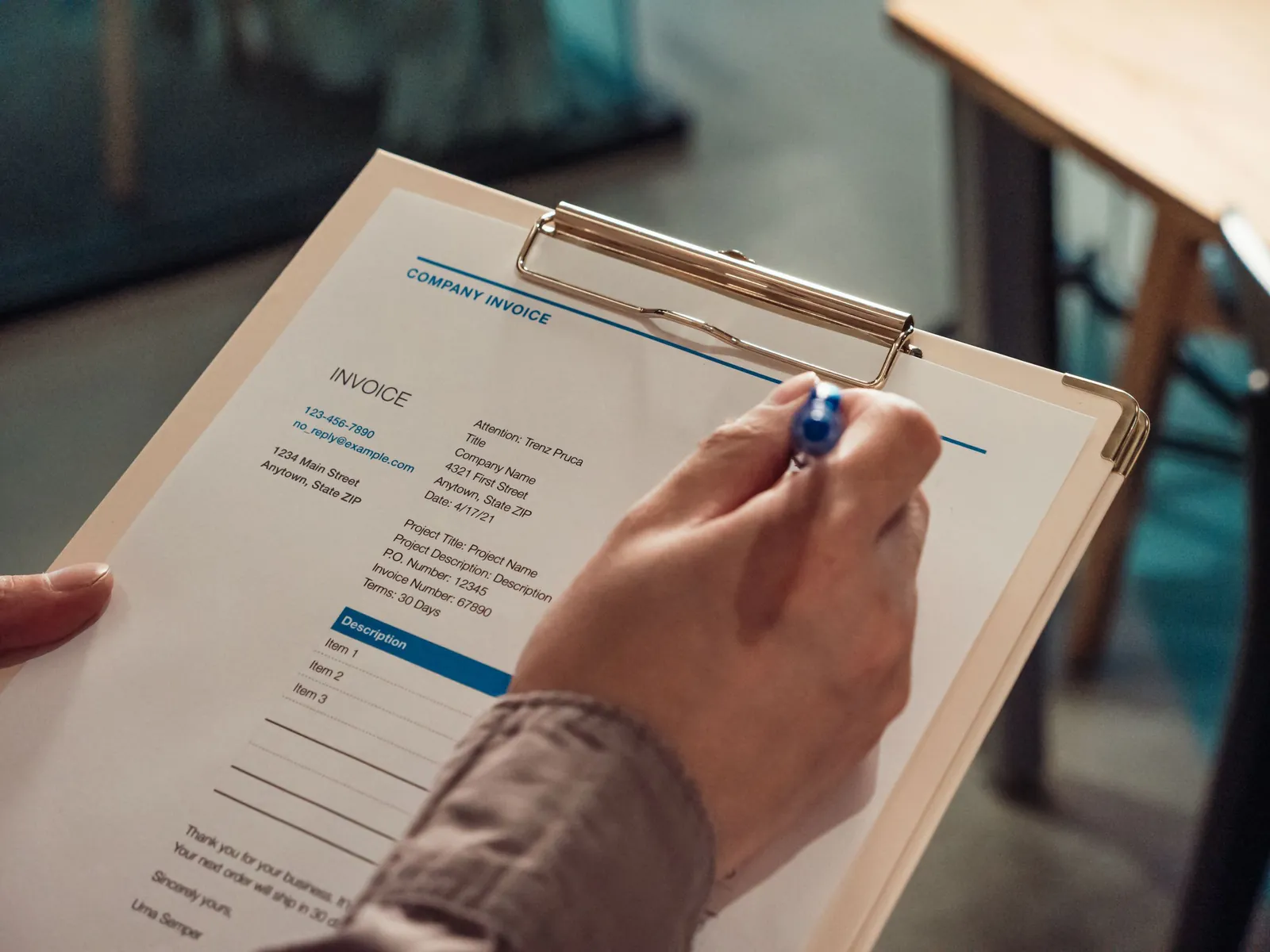
An invoice is a document a seller sends a buyer asking to be paid for goods or services already agreed. It lists who is billing whom, what was supplied, how much is owed and when payment is due. For the seller it records money coming in; for the buyer it's the document they check and approve before money goes out.
This guide covers a labeled sample invoice, the fields to include, how invoices differ from receipts, bills, quotes and purchase orders, the main invoice types, and what payment terms like 2/10 Net 30 mean.
Key takeaways
- An invoice is a request for payment. A receipt is proof that payment happened.
- Every invoice needs seller and buyer details, a unique invoice number, dates, line items, a total and payment instructions.
- The US has no federal list of required fields for private business invoices (billing a federal agency is the exception), and sales tax rules are set by each state.
- Payment terms such as Net 30 tell the buyer when the money is due; put the actual due date on the invoice too.
- Keep invoices with your tax records: at least three years under the IRS's general rule, and longer in some cases and in some states.
What is an invoice in accounting?
An invoice is a seller's itemized, dated request for payment. It turns an agreement ("I'll design your logo for $1,200") into a bill the buyer can approve, pay and file. Invoices are also called sales invoices or bills, depending on which side you're on.
The same document plays two roles:
- For the seller, it's part of accounts receivable: money owed to you. Until it's paid, it sits in your books as an open invoice.
- For the buyer, it's part of accounts payable: money you owe. Your team checks it against what you ordered before releasing payment.
Invoices usually come after the work or delivery. Some businesses invoice up front (a deposit, a retainer, a subscription), and construction jobs often invoice in stages as work progresses.
What does an invoice look like?
A typical invoice fits on one page: your business at the top left, the invoice number and dates at the top right, the customer under that, a table of line items in the middle, and the total with payment instructions at the bottom.

Layouts vary by industry. A freelancer's invoice may have three lines; a contractor's can run to two pages with labor, materials and retainage. The parts stay the same. If you want to see a few layouts side by side, the invoice design gallery shows all 16 designs, each with its own sample invoice.
What must an invoice include?
At minimum, an invoice shows who is billing, who is paying, what was supplied, the amount due, the due date and how to pay. Missing details, such as the buyer's PO number, are a common reason accounts-payable teams hold an invoice back. In practice that means these seven fields, in the same order as the labeled example:
- Seller details: legal business name, address, email or phone.
- Invoice number: a unique code that's never reused. See what an invoice number is and how to format one.
- Issue date and due date: write the actual due date, not only "Net 30".
- Buyer details: the customer's legal name and billing address. For companies, the accounts-payable contact and any PO number they gave you.
- Line items: description, quantity, unit price and line total for each item or service.
- Subtotal, tax and total: sales tax as its own line, only on items that are taxable where the sale happens.
- Payment instructions: accepted methods, bank or payment link, and any late-fee terms both sides agreed.
Is any of this legally required in the US? There's no general federal law listing mandatory fields for business-to-business invoices. Billing a federal agency is the exception: its Prompt Payment rules spell out what a "proper invoice" must contain (5 CFR 1315.9). State sales tax is the other big exception: each state decides what's taxable and how tax must be shown, so check your state's revenue department. The IRS also expects you to keep documents that support the income on your return, and it names invoices as one of them (IRS Publication 583).
Other countries set their own rules. If you register for VAT in the EU, your invoices must carry specific fields, including a sequential invoice number and the VAT amount (EU VAT Directive, Article 226). UK businesses must show a unique identification number on every invoice (GOV.UK). If you sell abroad, check whether you have to register for VAT there before you copy a foreign invoice format.
Want these fields laid out for you? The free invoice generator has seller and client details, invoice number, issue and due dates, line items with per-line tax, and a notes box for your PO number and payment instructions. No sign-up, no watermark.

What is the difference between an invoice and a receipt?
An invoice asks for payment; a receipt confirms payment was made. You send the invoice first, the customer pays, then you issue a receipt. Several other documents get confused with invoices, so here they are side by side:
| Document | Who sends it | When | What it says | Asks for money? |
|---|---|---|---|---|
| Quote / estimate | Seller | Before the work | "Here's what it would cost" | No |
| Purchase order (PO) | Buyer | Before the work | "We approve buying this" | No |
| Invoice | Seller | After delivery, or at agreed stages | "Please pay this amount by this date" | Yes |
| Bill | Seller (it's the buyer's name for an invoice) | Same as invoice | Same as invoice | Yes |
| Receipt | Seller | After payment | "We received your payment" | No |
| Statement | Seller | Monthly or on request | "Here are all your open invoices and payments" | Summarizes |

"Bill" and "invoice" are the same document seen from opposite sides of the desk. Your customer receives your invoice and enters it as a bill to pay.
What are the main types of invoices?
Standard invoices cover most everyday sales. The other types differ by timing and purpose: some go out before delivery, some bill part of a larger job, some repeat on a schedule, and credit and debit notes correct an invoice already sent. These nine cover nearly every case:
| Type | What it's for |
|---|---|
| Standard invoice | One-off sale of goods or services |
| Proforma invoice | A preliminary invoice sent before delivery, often for customs or to request a deposit; it isn't a final bill and isn't recorded as a sale |
| Interim or progress invoice | Billing part of a large job as stages are completed |
| Final invoice | The last bill on a project, often releasing any retained amount |
| Recurring invoice | The same charge on a schedule, such as a monthly retainer |
| Credit note (credit memo) | Reduces or cancels an earlier invoice after a refund, return or error |
| Debit note (debit memo) | Increases the amount owed on an earlier invoice, for example to correct an undercharge |
| Commercial invoice | Customs paperwork for international shipments, showing the goods' value |
| Timesheet invoice | Bills hours worked, usually with dates and tasks |
If you're a contractor billing labor, materials and change orders, the contractor invoice template guide walks through a filled-in example.
What is invoicing?
Invoicing is the full process of billing customers and getting paid, from agreeing on the price to filing the paid invoice. For a small business, it's the difference between work done and cash in the bank. It usually runs in six steps:
- Agree on the price, often with a quote or a signed contract.
- Issue the invoice with a unique number and due date. See how to create an invoice for a field-by-field walkthrough.
- Send it to the right person, usually by email with a PDF or a payment link. Here's how to send an invoice without it getting lost.
- Track it until it's paid: sent, viewed, overdue.
- Collect payment and send reminders if it's late.
- Reconcile: mark it paid, issue a receipt and file it with your records.
Small businesses often do all six by hand. That's fine at five invoices a month. At fifty, the step that breaks first is usually the boring one: copying amounts from one place to another. Nobody started a business to retype client addresses all afternoon.
What do invoice payment terms mean?
Payment terms tell the buyer how long they have to pay and whether there's a discount or penalty. They go on the invoice next to the due date. Write both the term and the actual date, because "Net 30" alone leaves the buyer to work out the date. The common ones:
| Term | Meaning | Example on a $1,000 invoice dated March 1 |
|---|---|---|
| Due on receipt | Pay as soon as you get it | Due March 1 |
| Net 15 / Net 30 / Net 60 | Full amount due within 15, 30 or 60 days | Net 30: due March 31 |
| 2/10 Net 30 | 2% off if paid within 10 days, otherwise full amount in 30 (definition) | $980 if paid by March 11; $1,000 by March 31 |
| EOM (end of month) | Due at the end of the month the invoice is dated | Due March 31 |
| Net 30 EOM | Due 30 days after the end of the invoice month | Due April 30 |
| CIA / CWO | Cash in advance / cash with order | Paid before work starts |
Late fees are far easier to collect when the customer agreed to them beforehand, usually in your contract or quote, and some states limit how much you can charge. State your late-fee policy on the invoice so it isn't a surprise.
What is an invoice payment?
An invoice payment is money a customer sends to settle a specific invoice, by ACH, card, check or a payment link. Good practice is to ask customers to quote the invoice number with the payment so you can match it. A partial payment leaves the invoice open with a balance; a full payment closes it, at which point you can issue a receipt.
How long should you keep invoices?
Keep each invoice for at least three years from the date you file the tax return it supports. That's the IRS's general rule for business records (IRS: How long should I keep records?). Your state may require longer: California asks sellers to keep sales and use tax records for at least four years (CDTFA Publication 116).
Some federal cases need longer:
- Six years if you left out income that is more than 25% of the gross income shown on your return.
- Seven years if you claim a bad-debt deduction.
- Indefinitely if no return or a fraudulent return was filed.
- Property you still own: keep the invoices until the limitation period ends for the year you sell or dispose of it.
Store invoices where you can search by invoice number, customer and date.
What is an e-invoice?
An e-invoice is an invoice sent as structured data that software can read directly, rather than a PDF a person has to read and retype. A structured e-invoice (in formats like UBL) can go straight into the buyer's accounting software, as long as both sides are connected to the same exchange network or accept the same format.
A PDF emailed to a customer is a digital invoice, but it isn't structured data: the buyer has to retype its numbers or run it through data-extraction software before their accounting system can use them.
Several countries now require e-invoicing for some or all business-to-business sales. The US has no federal B2B e-invoicing mandate today. Adoption is voluntary. One US option is the e-invoice exchange network overseen by the Digital Business Networks Alliance (DBNAlliance), formed in 2023 by participants in the Business Payments Coalition's E-invoice Exchange Market Pilot, which ran with Federal Reserve support (FedPayments Improvement). For most US small businesses, a well-formed PDF plus a payment link is still the norm.
How are invoices created automatically?
Automated invoicing takes data you already have, such as a spreadsheet row, an order or a timesheet, fills an invoice template with it and produces a finished PDF without anyone typing. The flow looks like this:
- Data arrives: a new row in Google Sheets, a record in Airtable, an order in your store.
- A tool maps the fields (customer, line items, tax rate) into an invoice request.
- The invoice is issued with the next number, the totals calculated and a PDF generated.
- It's delivered: emailed to the customer, saved to Drive, and the invoice number written back to the row.
ASHDOCS handles step 3 and the email in step 4 through the Invoice API. Send customer details and line items as JSON, and it issues the invoice with the next gapless number and returns the PDF link. It can also email the invoice with the PDF attached and a link to a hosted page the customer can pay from once you connect Stripe. Saving to Drive and writing the number back to your row are steps in your Zapier, Make or n8n flow.
From Google Sheets or Airtable, a Zap with Webhooks by Zapier (a premium app that needs a paid Zapier plan) can send each row to the API (Zapier setup), and an Airtable automation using the Run a script action can call it directly (check your Airtable plan, since Airtable's own help pages differ on which plans include it). In Make, use the HTTP module. In self-hosted n8n, install the ASHDOCS community node (n8n-nodes-ashdocs); on n8n Cloud, use the HTTP Request node until the node is verified. Test keys never use credits, so you can check the request and the PDF before you issue a real invoice.
Billing from a spreadsheet? Get a free test key and turn one row into an invoice PDF without using any credits.
Frequently asked questions
What is an invoice in simple terms? An invoice is a bill a seller sends to a buyer listing what was sold, how much is owed and when it must be paid. It's the formal request for payment, and both sides keep a copy for their records.
What are invoices used for? Invoices request payment, record sales for the seller, give the buyer a document to approve and pay, and serve as supporting records for taxes. They also settle disputes about what was agreed and when.
What is the difference between an invoice and a receipt? An invoice is sent before payment and asks for money. A receipt is sent after payment and confirms the money was received. A paid invoice and a receipt can cover the same sale, but they're different documents.
Is an invoice the same as a bill? Yes. It's the same document seen from different sides: the seller calls it an invoice, and the buyer usually records it as a bill to pay.
Who sends an invoice, the buyer or the seller? The seller sends the invoice. The buyer may send a purchase order beforehand, but the invoice normally comes from whoever is being paid. The exception is self-billing, where the buyer prepares the invoice for the supplier under a written agreement.
Does an invoice need a tax ID in the US? Not for most private sales. Invoices to federal agencies must include your Taxpayer Identification Number unless the agency's procedures say otherwise. Some business customers also ask for your EIN or a Form W-9 before paying, and some states require specific sales tax details, so include them when asked.
Invoices in short
An invoice is a seller's dated, itemized request for payment. It needs seller and buyer details, a unique number, dates, line items, a total and payment instructions. It's different from a receipt (proof of payment), a quote (a price before work) and a purchase order (the buyer's approval). Keep invoices with your tax records, and if you're sending more than a handful a month, generate them from your data instead of retyping them.
Sending invoices from a spreadsheet every month? The ASHDOCS Invoice API issues, numbers and emails an invoice for each row your Zapier, Make or n8n flow sends it.
Make your first invoice now with the free invoice generator. No sign-up, no watermark.